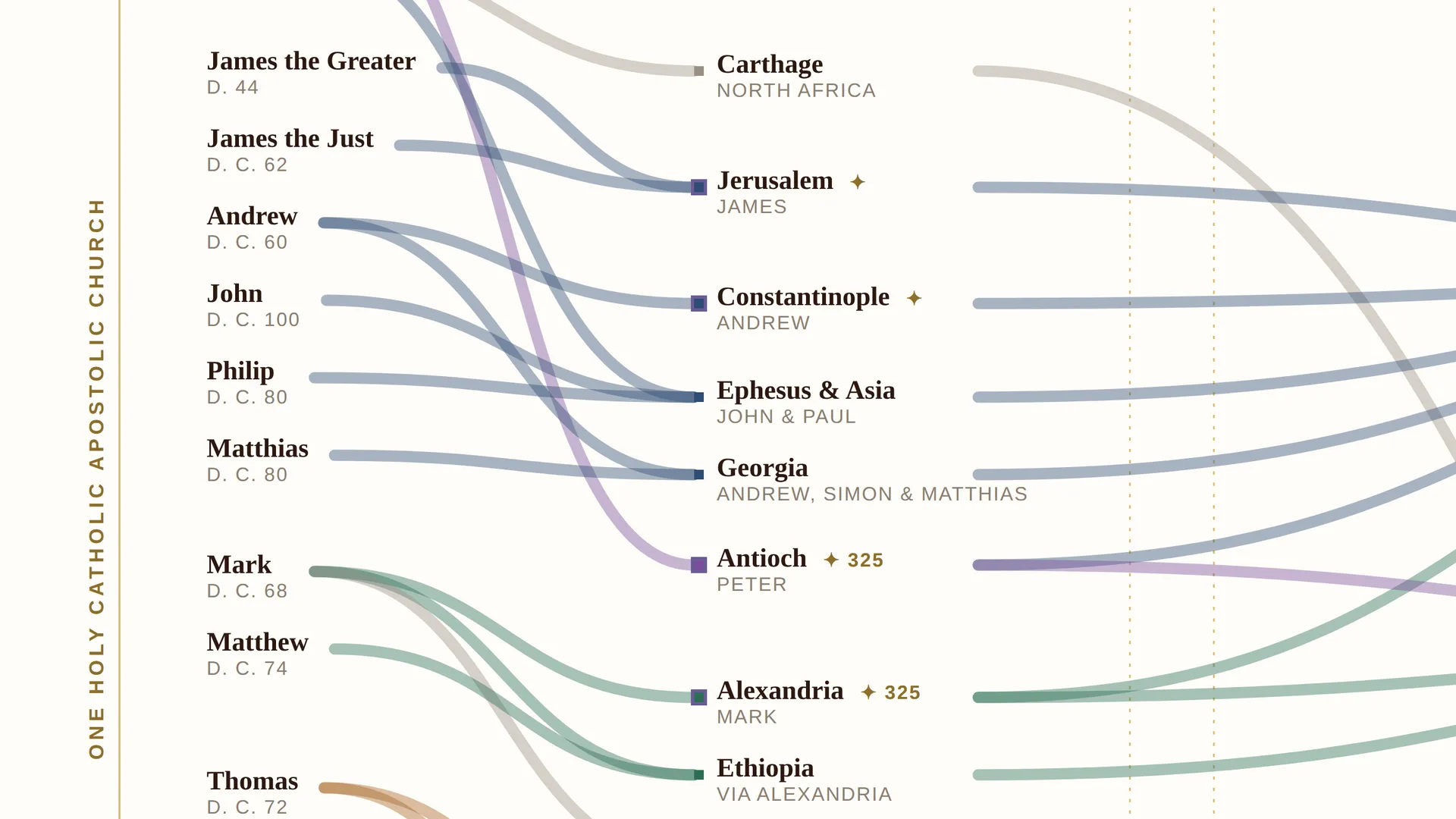
The last article in this series traced where each of the Twelve went, and showed that the rites their churches grew into — Latin, Byzantine, Alexandrian, Syriac, Armenian — still converge today, mostly in the Catholic Church. But a chart of where the lines go doesn’t tell you what the people at the end of them actually believe. This piece does.
The splits were narrow, not total
Start with a fact that gets lost once you’re staring at two thousand years of division: every real split among the apostolic churches was a fight over one specific thing, not a wholesale re-founding of the faith.
The Church of the East parted ways after Ephesus in 431 — a dispute over how to speak about Christ’s two natures and whether Mary could rightly be called Theotokos, God-bearer. The Oriental Orthodox churches (Coptic, Armenian, Syriac, Ethiopian) parted ways after Chalcedon in 451 — a dispute, again, over the precise wording for how Christ is both God and man. Rome and Constantinople split in 1054 — not over Christology at all, but over the pope’s authority and a single added word in the Creed (filioque). Three splits, three arguments, each one genuinely narrow enough to state in a sentence.
What that means is worth sitting with: everything outside those specific disputes — the whole architecture of how these churches worshipped, organized themselves, and lived — was already settled and shared before any of the splits happened. Nobody walked away from Chalcedon and started inventing a new kind of Christianity from scratch. They kept everything they already had and disagreed about one thing. That’s why a Coptic Christian in Cairo, a Syriac Christian in Kerala, an Orthodox Christian in Moscow, and a Byzantine Catholic in Pittsburgh can still recognize each other’s churches on sight — the liturgy, the vestments, the icons, the fasting, the whole shape of the thing — even where they don’t share communion.
What Bible Alone Misses
“Therefore let us leave the elementary doctrine of Christ and go on to maturity, not laying again a foundation of repentance from dead works and of faith toward God, with instruction about ablutions, the laying on of hands, the resurrection of the dead, and eternal judgment.” (Hebrews 6:1-2)
Let’s start with a quick understanding of what the Bible represents in terms of the scope of its teaching. It was never meant to be a comprehensive bullet pointed list of all beliefs that Christians were taught by the Apostles. In fact, by its own admission certain things were explicitly kept out of the written letters because they were too elementary and basic. This was practical for the time period, verbally explained doctrines were cheap. Written parchment was a luxury. Theres multiple other areas where its more than implied. In fact, the one phrase many “bible only” doctrines come from actually refutes it as a doctrine.
“…that you may learn by us not to go beyond what is written, that none of you may be puffed up in favor of one against another.” (1 Corinthians 4:6)
Apparently, even in ancient times, the concept of “bible only” was being wrongly applied by certain churches. Paul corrected it by explaining it was more about not becoming puffed up and arrogant, opposed to a strict legalistc sense of only what is in the Bible.
The Shared Apostolic Inheritance
Here is that shared inheritance at a glance — the four apostolic families, still divided from one another, set against the typical newly-founded church down the street:
| Belief | Catholic | Eastern Orthodox | Oriental Orthodox | Church of the East | Non-Denominational |
|---|---|---|---|---|---|
| Apostolic succession | ✓ | ✓ | ✓ | ✓ | ✕ |
| Centralized structure | ✓ | ✓ | ✓ | ✓ | ✕ |
| Priests ordained by bishops | ✓ | ✓ | ✓ | ✓ | ✕ |
| A real, sacramental Eucharist | ✓ | ✓ | ✓ | ✓ | ✕ |
| Fixed formal liturgical worship | ✓ | ✓ | ✓ | ✓ | ✕ |
| Confession aloud to a priest | ✓ | ✓ | ✓ | ✓ | ✕ |
| Infant baptism | ✓ | ✓ | ✓ | ✓ | ✕ |
| Mary given exceptional honor | ✓ | ✓ | ✓ | ✓* | ✕ |
| Mary's perpetual virginity | ✓ | ✓ | ✓ | ✓ | ✕ |
| Veneration of the saints | ✓ | ✓ | ✓ | ✓ | ✕ |
| Living monastic tradition | ✓ | ✓ | ✓ | ✓ | ✕ |
| Fixed fasting & feasting calendar | ✓ | ✓ | ✓ | ✓ | ✕ |
* The Church of the East honors Mary deeply but has historically preferred the title "Mother of Christ" to Theotokos — see the note below the chart.
* The Church of the East honors Mary deeply but has historically preferred the title “Mother of Christ” to Theotokos — the very distinction behind the 431 split described above. A 1994 joint statement between Pope John Paul II and the Assyrian Church’s Catholicos affirmed both titles as legitimate expressions of the same faith.
Bishops, not self-starters
Every apostolic church, without exception, is governed by bishops standing in an unbroken line of ordination back to the apostles. Nobody in an apostolic church simply decided one day that he had the authority to preach, baptize, and forgive sins in Christ’s name — that authority was handed to him, by men who received it the same way, in a chain running back to the Twelve.
Paul makes the pattern explicit to Timothy: “what you have heard from me before many witnesses entrust to faithful men who will be able to teach others also” (2 Timothy 2:2) — four generations of transmission named in one verse. He tells Titus to “appoint elders in every town” (Titus 1:5), and reminds Timothy of “the gift you have, which was given you by prophetic utterance when the council of elders laid their hands upon you” (1 Timothy 4:14). Ordination, in the New Testament, is something given, hand to hand, not something a man claims for himself.
Compare that to how a new congregation typically starts today: someone feels called, rents a storefront, and starts preaching — answerable to no bishop, no council of elders, no chain of anything. That may be sincere. It is not the pattern Scripture shows.
One body, not a loose federation
Every apostolic church is governed as a single connected structure, not a scattering of independent congregations each doing as it sees fit. That pattern shows up as early as Acts 15: when a dispute over Gentile converts threatened to split the young Church, it wasn’t left to each local congregation to decide for itself. The apostles and elders gathered in Jerusalem, deliberated, and issued a decision binding on every church the letter reached, closing with the striking claim “it has seemed good to the Holy Spirit and to us” (Acts 15:28). That is centralized authority, exercised in the very first generation.
The same structure runs downward, not just across. A priest, in every apostolic church, is ordained by a bishop and serves under his authority — never hired, elected, or self-appointed by the congregation he serves. Paul and Barnabas didn’t leave each new church to raise up its own leadership independently: “when they had appointed elders for them in every church, with prayer and fasting they committed them to the Lord” (Acts 14:23).
A real Eucharist
Every apostolic church holds that the bread and wine of the Eucharist actually become the Body and Blood of Christ — not a symbol pointing to Him, but Him. Christ’s own words leave little room for a symbolic reading: “unless you eat the flesh of the Son of man and drink his blood, you have no life in you” (John 6:53). His hearers understood Him literally and were scandalized by it — and He let them walk away rather than soften the claim. Paul assumes the same realism when he warns that whoever eats the bread or drinks the cup “in an unworthy manner will be guilty of profaning the body and blood of the Lord” (1 Corinthians 11:27) — a strange thing to say about a mere symbol.
This is worship at its most demanding, and every apostolic communion has kept it, even through every dispute that ever divided them from one another.
Worship that was never improvised
Walk into a Coptic liturgy, a Byzantine Divine Liturgy, or a Syriac Qurbana and you’ll hear prayers with fixed words, said in a fixed order, that the congregation has heard a thousand times before. This isn’t an accident of history — it’s the pattern from the very beginning. Luke describes the first believers in Jerusalem as devoting themselves “to the breaking of bread and the prayers” (Acts 2:42) — not “a prayer,” but the prayers, definite article included, as if everyone already knew which ones. Structured, repeated, communal worship is as old as the Church itself.
Confession, out loud, to a priest
Every apostolic church retains sacramental confession — sins spoken aloud to a priest, not merely confessed silently to God alone in private prayer. The authority behind it goes back to the resurrected Christ Himself, breathing on the apostles: “Receive the Holy Spirit. If you forgive the sins of any, they are forgiven; if you retain the sins of any, they are retained” (John 20:22-23). That is a real authority, given to real men, to exercise on other real people — which requires the sin to actually be brought to them. James assumes the same thing: “confess your sins to one another, and pray for one another, that you may be healed” (James 5:16).
The whole family baptized, from infancy
Every apostolic church baptizes infants, not just adult converts who can first profess their own faith. The pattern shows up repeatedly in Acts, where whole households are baptized at once with no mention of age or individual profession — Lydia “was baptized, with her household” (Acts 16:15); the Philippian jailer “was baptized at once, with all his family” (Acts 16:33). Paul draws the theological line straight from the old covenant to the new: just as an eight-day-old boy was circumcised into Israel without being asked his opinion, a Christian is “buried with him in baptism” (Colossians 2:12) as the New Covenant’s replacement for that same sign — applied, like circumcision, to the whole household. Nowhere does the Bible give an age limit for receiving God’s love or being in His covenant.
Mary, greatly honored, and ever-virgin
Every apostolic church gives Mary a place of honor no other saint receives, and every apostolic church holds that she remained a virgin her whole life — before, during, and after Christ’s birth. Mary herself prophesies the first of these under the Holy Spirit’s inspiration: “henceforth all generations will call me blessed” (Luke 1:48) — not a suggestion, a prophecy, and one every apostolic church has kept fulfilling for two thousand years. Her perpetual virginity is written into her own words at the Annunciation — told she will conceive a son, her question is not how soon but how at all: “How can this be, since I have no husband?” (Luke 1:34), a strange thing for a betrothed woman in that context to ask, unless she had already given her body to God alone.
The whole cloud of witnesses
Every apostolic church asks the saints — the faithful departed, alive in Christ — to pray for them, the same way you’d ask a friend still living. Hebrews pictures the Christian life as run in a stadium “surrounded by so great a cloud of witnesses” (Hebrews 12:1); Revelation shows the prayers of God’s people rising before the throne as incense, carried by the twenty-four elders (Revelation 5:8). Death does not retire a Christian from the Body of Christ. It’s the same instinct behind asking a friend at church to pray for you — extended to friends who happen to already be with the Lord.
Monks and nuns, still
Every apostolic church has an unbroken, living tradition of monasticism — men and women who give up marriage entirely to devote themselves to prayer. Christ Himself makes room for it, speaking of those who “have made themselves eunuchs for the sake of the kingdom of heaven” (Matthew 19:12), and Paul commends the unmarried state for exactly this reason: freedom for “undivided devotion to the Lord” (1 Corinthians 7:35). This isn’t a relic from another century — the monastery down the road from you, whatever apostolic tradition it belongs to, is that same calling, still being lived out today.
A rhythm of fasting and feasting
Every apostolic church keeps a real, structured calendar of fasts and feasts — not occasional private discipline, but a shared rhythm the whole church moves through together, year after year. Christ assumes His followers will fast as a matter of course — “when you fast” (Matthew 6:16), not if — and the early Church fasted corporately, together, before major decisions: the church at Antioch was “worshiping the Lord and fasting” when the Holy Spirit set apart Paul and Barnabas for their mission (Acts 13:2). Every apostolic church still organizes its year this way, whatever the local names for the seasons.
What this rules out
Put those together — apostolic bishops, a real Eucharist, fixed liturgical worship, confession to a priest, infant baptism, Mary honored and ever-virgin, the saints asked to pray for us, monks and nuns, a shared calendar of fasting and feasting — and you have described something no independent congregation founded in living memory can claim — the beliefs that were taught by the Apostles. Prior to the 1500s, every single Christian held, among others, that set of beliefs.
That’s the real answer to the question this series opened with: not which apostolic rite got it most right, but that all of them, whatever else divides them, are still holding the same inheritance the Twelve carried out of Jerusalem — while the newest church in town, however good its intentions, is holding an opinion.
There’s a thread running under everything in that chart, easy to miss because it’s everywhere in it at once: grace arrives first, and faith grows out of it — an infant baptized before he can believe anything for himself, bread and wine that become Christ’s Body whether or not the one receiving them feels it, absolution spoken by a priest ordained through no effort of his own. That order, grace before faith, turns out to be the sharper line — not just between the apostolic churches and the newest congregation down the street, but between the apostolic churches and two much bigger faiths that get grace and faith backward in strikingly similar ways. That’s next.
Scripture. As the apostolic Church read it.