Once when I was visiting a Ma and Pa non-denominational church I had asked an important question - how their church started. The specific one I was visiting had an interesting story - started around 1980 by their charismatic pastor who had gotten his start doing bathtub baptisms in his house. He had felt inspired by the Holy Spirit with a divine revelation that he needed to start a church in small town USA. His church was the true Christian church and taught a true version of the faith. Other worshippers attested - this church had The Spirit in It. All other churches were wrong.
For what it’s worth I did not return to that specific church after that; for varying reasons.
Ask any modern Christian where his church came from and you will usually get a similar story - some man had an opinion and took it upon himself to discern what the true faith was. Some do it for noble reasons, others are more concerned with their merchandise store and coffee shop.
Ask the same question of a Christian of an Apostolic tradition - Armenian, a Copt, a Malabar Indian, a Roman Catholic, or a Ruthenian, and you get a name and a road: Bartholomew came here, Mark came here, Thomas came here, Peter set up shop here. This is how the physical church Christ started took root and spread. And this story is the beginning of our “Apostolic Foundations” series where we explore the ancient foundations of Christ’s physical church.
This first article explores their story, where they went and where you can find the churches they established today. Because Christ didn’t leave us a bible, He left us a centralized church with its foundations in the Twelve. They in turn founded churches that coalesced into various rites which then formed various communions of churches that are still around to this day. This is their story.
Out of Jerusalem - Where each Apostle went
For a decade and more after Christ’s death the Twelve kept close to home, preaching in Jerusalem and Judea — to Israel first, eventually to neighboring Samaria. What broke that open was a killing: about the year 44 AD, Herod Agrippa “killed James the brother of John with the sword” (Acts 12:2), the first of the Twelve to die. The persecution and terror that took him drove the rest out of the city. From then on they continued scattering, each to his own country, to be Christ’s witnesses. Where each of them went we know mostly from historically written tradition, and the traditions vary — but they agree on the shape of the thing: twelve men and a few companions, walking in every direction until the known world had a church in it.
- Peter — Always listed first and generally accepted as the leader of the Twelve. He preached to the Jewish diaspora of Asia Minor (1 Peter 1:1), held the see of Antioch, and came at last to Rome, crucified there under Nero sometime between 64-66 AD. Originally named Simon, until Christ renamed him Cephas — Aramaic for “rock,” which comes into Greek as Petros and into English as Peter. The Roman church rests on his name and Paul’s.
- Paul — Technically not one of the Twelve; one of the greatest redemption stories in church history, he started as a great persecutor of the church, consenting to the stoning of St. Stephen (Acts 7:58–8:1), and became its greatest Apostolic writer - writing the most New Testament letters and simply becoming known as The Apostle. He was called late, on the road to Damascus, and made the apostle to the Gentiles: Cyprus, Asia Minor, Greece, and Rome, a church planted in city after city. Given credit as a founder of the church in Rome for helping it expand greatly, even though it was already established prior to his first visit according to his letter to the Romans. Beheaded at Rome around the same time as Peter.
- James the Greater — Son of Zebedee and Salome, John’s brother, and the first of the Twelve to die — killed at Jerusalem about 44 AD, the death that set the others moving. He is also credited with helping to start the church in Spain, although this tradition is not as well attested in the earliest records.
- James the Just — Known as the brother of the Lord. Son of Alphaeus and the other Mary, not Mary the mother of Jesus. The first church historian Eusebius records him as the first bishop of Jerusalem ( as evidenced by Acts 15 ), until his own martyrdom about 62 AD. The liturgy that bears his name is the oldest that survives.
- Andrew — Peter’s brother, apostle of the Black Sea coasts and of parts of Greece, and the founder Byzantium claims — which is why Constantinople is counted an apostolic see. Known in the Orthodox tradition as the First-Called (Protokletos) — the first of the Twelve to follow Christ, and the one who then brought his brother Peter to him (John 1:40–42). Crucified at Patras on the X-shaped cross that bears his name.
- John — The beloved disciple and evangelist, who made Ephesus his own and oversaw the churches of Asia Minor. He wrote the Gospel that bears his name, and is traditionally associated with the John who authored Revelation. Exiled to Patmos, he alone of the Twelve died peacefully in old age, about 100 AD or just a little before.
- Philip — Apostle of Phrygia — an ancient region in west-central modern-day Turkey — who died at Hierapolis; his tomb was uncovered there in 2011, one of the best-attested apostolic graves in Asia Minor.
- Matthias — Chosen by lot to fill Judas’s place among the Twelve (Acts 1:26). Tradition sends him north to Colchis, in what is now Georgia, whose church claims Andrew as well.
- Mark — The evangelist and not technically one of the Twelve; a disciple of Peter and companion of Paul, founder of the church in Alexandria, martyred there about 68 AD. The Coptic and Ethiopian churches trace their succession through him.
- Matthew — The tax collector turned evangelist; after preaching among his own people, remembered for going south toward Ethiopia — a mission the church in Alexandria would carry on.
- Thomas — The apostle who went farthest: through Persia and on to the Malabar coast of India, where the Saint Thomas Christians have borne his name for nineteen centuries. Killed near Mylapore about 72 AD, run through with a spear.
- Jude Thaddeus — Or sometimes just known as Thaddeus. Apostle of Mesopotamia and Persia, known to the Syriac churches as Addai and counted, with Mari, among their founders; tradition has him martyred in Persia beside Simon.
- Simon the Zealot — Paired with Jude in the Armenian and Persian accounts, and with him in death; other traditions send him to Egypt or farther west. The evidence is late either way.
- Bartholomew — Apostle of Armenia with Thaddeus — the two honored as its first illuminators — and, tradition says, flayed for the faith at Albanopolis.
By most accounts all the Twelve but John were martyred, most of them in distant lands and within the first century. All of them started the process of spreading the Christian faith to the four corners of the world. As this process organically unfolded slight variances occurred from region to region. While the initial church had centralized structure and teachings, all coming from the same root and foundation which was Christ, they were limited by the technology of the time. They didn’t have email, or telephones. Even writing was difficult and expensive; having your own books and letters was a luxury item. Being able to write was a bona fide specialty. The result was predictably that as the faith spread to the far corners, minor variances occurred. Different languages were spoken. Different building styles utilized. Different analogies used to explain the same faith. Always the same universal faith, just expressed differently.
The Churches Coalesced into the Apostolic Rites
As churches spread sporadically to various cities, they would naturally form pockets of language-centric, geo-politically constrained groupings that did things and explained things similarly. The process was not organized but organic - and as a result messy. Cultures changed and coalesced, languages changed over time, and borders shifted constantly. But the churches, when founded, mostly endured. In modern times we call these sets of variances in worship style and specific traditions on explanations and viewpoints rites. There is a distinction between a rite, and a church (more properly described as a communion) that we will cover later. For now its important just to note that the two are not 1-1 and not mutually exclusive. A church/communion ( Catholic, Orthodox ) can be composed of many rites, and various rites ( Byzantine for instance ) cross church borders. Its important also to note that a rite can have different liturgies or specific worship rubrics. For instance the Latin Rite Catholic church has a Traditional Latin Mass and a post-Vatican II (1962–1965) modern style of worship; but both are still part of the same Latin Rite.
There were several of these rites that survived to the modern times:
-
Latin Rite - The largest practicing Christian rite in the world. The rite of the Western Churches of the Roman Empire centered around Rome. Coalesced out of a series of other rites and liturgies, some of which are still practiced today — the Ambrosian rite of Milan and the Mozarabic rite of Spain. It survives only in the Catholic church and is the only one that has not split and fractured into other rites.
-
Greek Rite AKA Byzantine Rite - called so because it originated mostly in the urban world of Constantinople - previously called Byzantium before being built up and renamed by the Emperor Constantine. Constantinople from the fall of Rome in 476 AD until its conquest in 1453 was the undisputed cultural center of the Christian world — home to the Hagia Sophia, the largest cathedral in the world for nearly a thousand years, and holding pieces of the True Cross along with uncountable other relics. The Slavic traditions are offshoots of this rite. The Byzantine Rite itself is a theological and academic offshoot of the Antiochean theological schools and was heavily influenced by the Cappadocian church fathers.
-
Alexandrian Rite - Originating in one of the two ancient Christian academic centers - Alexandria, this rite still exists primarily in the Oriental Orthodox churches and also in the Catholic Church. It is the rite of the Coptic (Egyptian) and Ethiopian churches.
-
West Syriac Rite - AKA Antiochene. Originating in the other ancient Christian academic center - Antioch, where the disciples were first called Christians. It’s currently used by the Lebanese Maronite Catholic Church, the St. Thomas Christians of the Syro-Malankara Catholic Church, and various Oriental Orthodox churches.
-
East Syriac Rite - AKA Chaldean or Persian. This rite was the main rite of the Church of the East - which for a time perhaps matched or exceeded the size and spread of Christians in the western world - even reaching as far as China. It was ultimately reduced to a mere shadow of itself by centuries of Muslim oppression that culminated in the devastating campaigns of Timur, whose armies left entire Christian cities executed and martyred. The church that first evangelized China and had millions of adherents now has less than half a million. This rite is also used by the St. Thomas Christians of the Syro-Malabar Catholic Church, one of the larger Catholic churches.
-
Armenian - Originating in Armenia, the first nation to formally adopt Christianity, this rite is currently used by the Armenian Catholic Church and the Armenian Apostolic Church (Oriental Orthodox).
Each of these rites represents something important, a real living record of the ancient churches created by the Apostles: what they were taught, how those teachings were explained, how the various ancient Christian churches worshipped, and how they were organized. These churches and rites were already old before the standard Western biblical canon was settled by the early bishops in the late 300s, at Hippo and Carthage. Some of the churches and rites mentioned even have different bibles that list different books.
The real question: which rite is right?
A natural response might be to ask which rite is right — which version of Christianity is correct, which Apostle got it most right. It’s an interesting question, but perhaps not the most proper one to ask - after all, when the Apostles themselves argued about which of them was greatest, Jesus seemingly chastised them for it. The real question we are really looking to answer lies a layer deeper. If from the beginning the church apparently was divided — spread by twelve Apostles to the far reaches of the known world, in different languages and different rites — is the Christian faith just one relative decentralized mess with each church practicing whatever it believed was best? Furthermore, can an entity like the Catholic Church also call itself the “Universal” Church if all Christian churches were decentralized from the start, and is there such a thing as a true “universal” church at all?
No to the first, yes to the rest — and for several reasons. First is that the church, from the beginning was not divided, it was unified and centralized. On Pentecost, for instance, Peter and the Apostles spoke and every listener heard it in his own mother tongue. The church started as one centralized communion — one faith, one foundation in Christ — even as it was heard in many languages at once. It was only worldly limitations, no instant communication or mass transit, that resulted in the splintering based on geo-political and cultural lines.
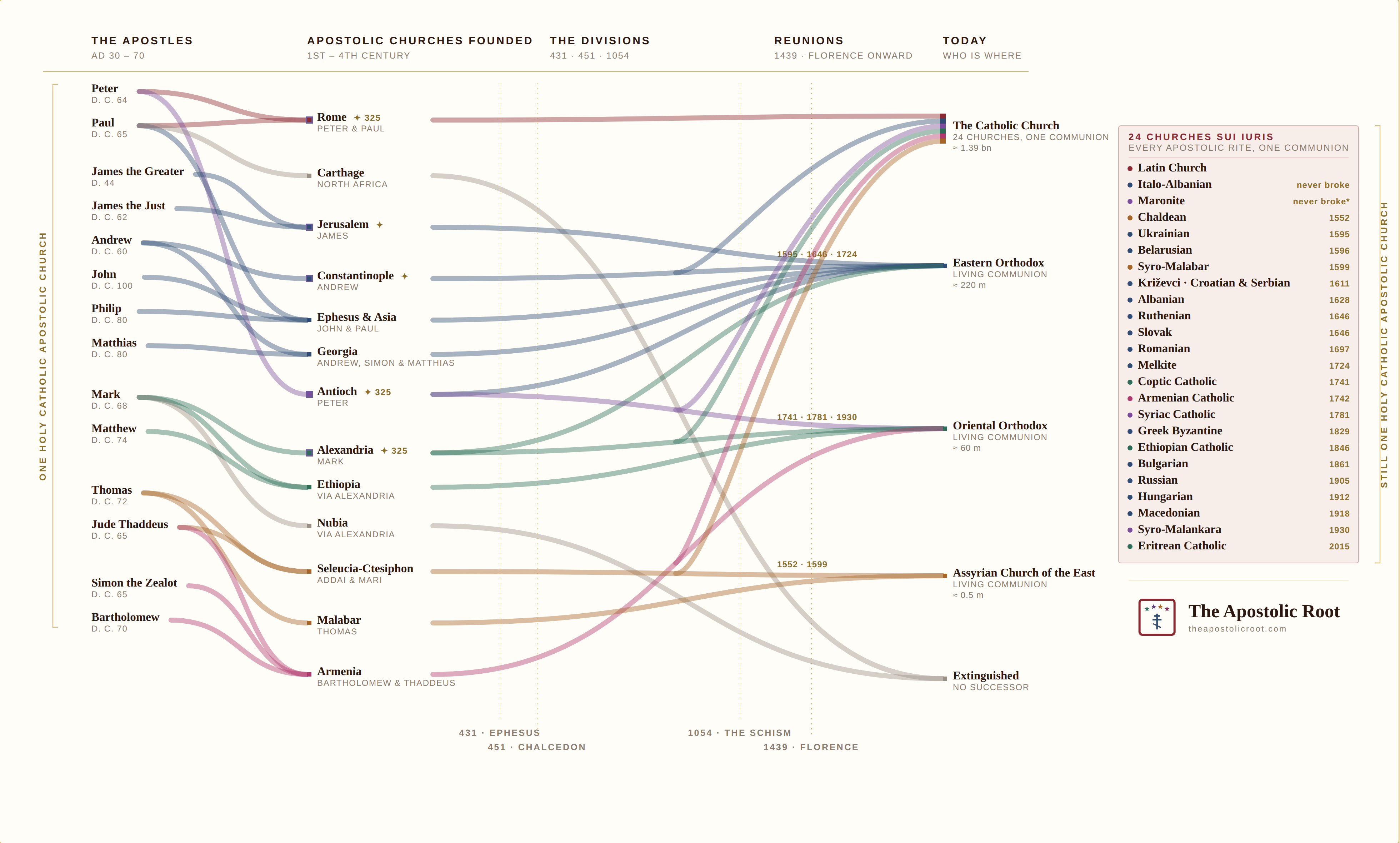
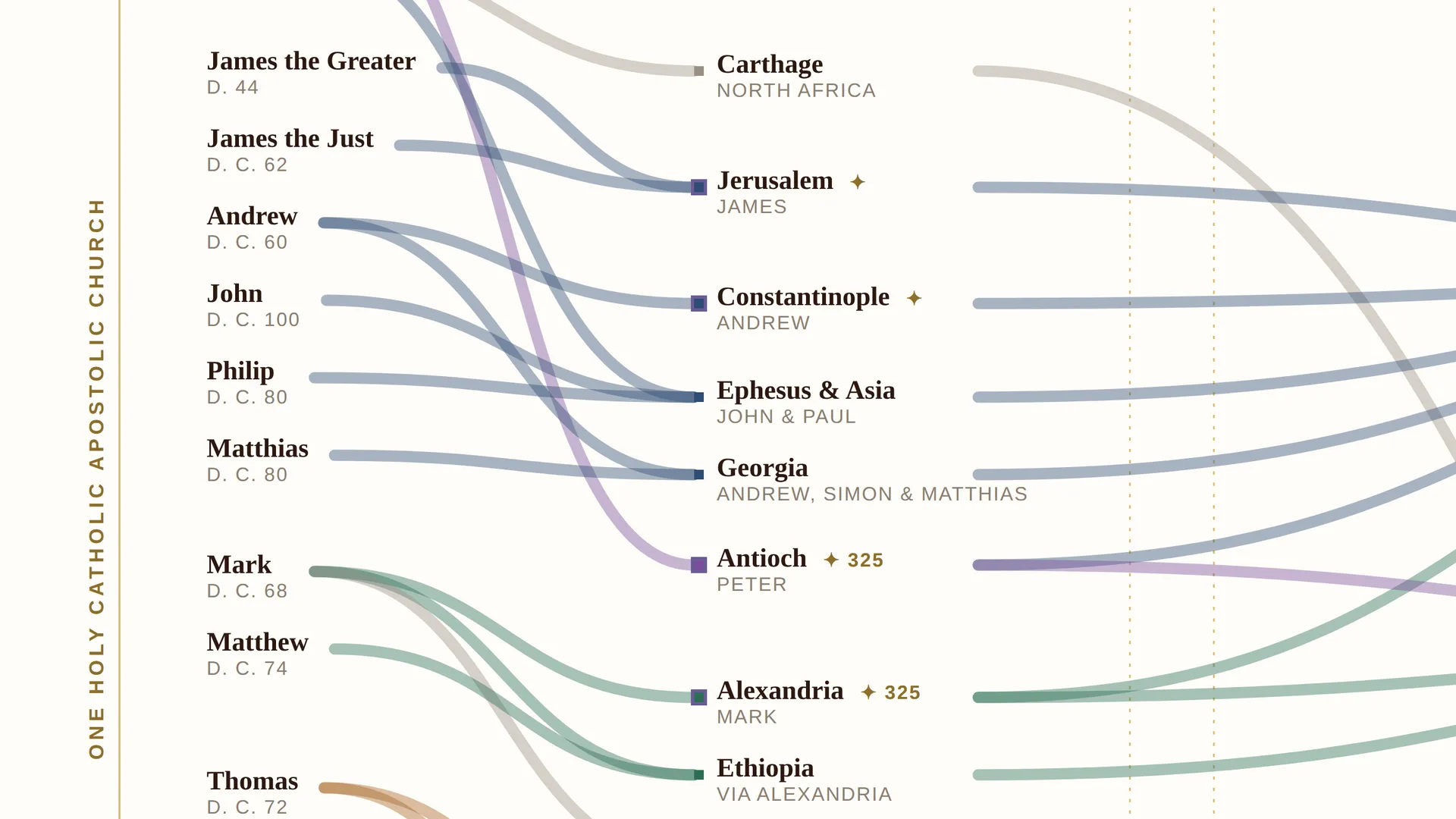
And here is the more important part, even as Christianity continues to fracture - with new modern charismatic & non-denominational churches in the west showing up daily, and new schisms in the East - the Catholic Church has started living up to its name as the Universal church becoming a stronghold of Apostolic Churches and rites joined in communion. The Catholic Church, and only the Catholic Church, has the fullness of all the Apostolic rites and traditions that came out of the Apostolic age. And you can see it visually in the chart below:
How to read it
Read it left to right, as a rough timeline with colored ribbons indicating various rites that coalesced from the individual churches founded by the Apostles.
The first column is the Twelve plus Mark the Evangelist and Paul, organized by where tradition says each one planted a church — a few churches claim more than one founder, and those are drawn as separate ribbons rather than merged - for instance Rome and Antioch both claim Peter as a founder so he has two ribbons coming out of his name.
The second column is the churches they founded, each one being an early center of Christianity; not all churches are listed, and some are grouped — for instance the “Asian” churches of Asia Minor. From there each line runs on to the communion that carries it today: with convergences, divergences, and in a few unfortunate cases disappearances.
Color is rite. Every ribbon’s color indicates its ritual family — Latin, Byzantine, Alexandrian, Syriac, Armenian, or the Persian line of the East. Follow a color and you are following a way of praying as it travels down the centuries. A gray ribbon is a line that died out.
The last column is who is standing where now — the modern Apostolic Communions still surviving.
The panel beside the Catholic Church. Throughout the ages, various churches have returned to the main Catholic Church. When this happens it constitutes what is called a Sui Iuris Church: a church with its own properties, its own separate priests, and its own leadership, that has sought unity over division. These churches retain their autonomy and separateness, but still recognize the overall authority of the Pope as visible spiritual head of Christ’s Church on Earth. This red panel lists all the different churches and when they entered or re-entered union with the Catholic Church.
Tap for more info - Tap anywhere on the map and you will get a tooltip providing more details.
Things to Note - The Catholic Church is the only church that can claim to represent all rites established by the Apostles that are known and have survived to this day. And there are at least two ‘dead’ possible lineages that did not continue on in any form to this day - Christian North Africa and Christian Nubia - both of which died out as a result of Muslim occupation.
* The Maronite claim. Every other date in the Catholic band marks a return from a real separation. The Maronites hold that none ever happened — communion with Rome lapsed in practice through the centuries of Muslim rule and was formally renewed in 1182, the date most sources print — so where the others say “reunited,” the chart gives the Maronites the benefit of the doubt.
Want the chart on your back instead of your screen? A condensed version of this story — Jesus, the twelve, the six rites, the four apostolic churches, and the question Can you find your church? — is printed on the back of our Apostolic Family Tree Tee, Hoodie and Hooded Long-Sleeve, with One Holy Catholic Apostolic Church across the front. For the younger members of the family there are youth and toddler tees carrying the Four Marks of the Church.
Where this leaves us
The visible claim of the above chart is that the fullness of the apostolic rites — every tradition the Twelve carried out of Jerusalem — is gathered today in a single communion: the Catholic Church.
But a chart can only show that it happened; it cannot tell you why it should matter - why is it important where we get our teachings from? And what are those teachings that unite all apostolic faiths, and how do they differ from the teachings of the modern day pastor plucked off the street? These questions will be answered in the follow up piece to this article.
Until that next article is written, there is somewhere else to go from here. If this is your first stop on the site, the Core Faith series is the curated path — ten articles walking through what the Byzantine Catholic Church actually believes, how it worships, and where the deeper theology lives, each one linking on to the next. It begins with What Is the Byzantine Catholic Church?